Sunday, June 17, 2012

Milagro en La Palma


Esta es la Comunidad de la Palma , ubicada en la Isla de Ometepe , con unos 120 casas, donde la mayoría de las personas prefesan la religión católica , desde hace mas de 2 años hemos estado visitando esta comunidad y desde que iniciamos fueron jóvenes entre los 14 a 17 años las participantes la mayoría mujeres , al principio hubo bastante oposición con el Liderazgo Catolico el delegado de la Palabra el señor Salomon Alvarez fue quien nos dio el recibimiento y nos pregunto sobre nuestro propósito en la comunidad , le hablamos de las bases de ECS y que era ECS en la realización de un seminario de visión , se dieron los pasos correspondiente , para la certificación de l programa en la comunidad y que este contara con el apoyo de las fuerzas vivas en ella , y asi fue .

 Gracias a Dios hace algunos meses con los temas que hemos estado impartiendo tanto físicos como espirituales creemos que Dios ha venido realizando el trabajo en estas jovencitas . El dia 23 de mayo del corriente año impartimos , la lección de la Bendicion de Dios , pero además incluimos la cita de Juan 6: 35 , Dicho esto por el contexto que hibamos a realizar era la elaboración de pizza y queríamos darle un poco mas de propiedad espiritual a la enseñanza , fue entonces que hicimos el llamado a las jóvenes cuando le mencionamos que ( es muy lindo a prender hacer pan , repostería entre otras cosas , pero mas lindo era el saber que si creíamos en Cristo NUNCA mas tendríamos hambre , ni sed .

 Fue entonces que ocurrió el milagro de que estas jóvenes las 19 aceptaron a Dios en ese momento , la verdad la hermana Juanita Alvarado Lider de Zona en la Isla y Yo NO lo podíamos creer ,preguntamos 3 veces y fue la misma respuesta , inmediatamente proseguimos a orar con ellas y la profesión de Fe. 


Creemos que Dios esta en control de todas las cosas , ahí no mas llegaron los lideres cataolicos y dijeron que eso que ellas asian era normal ya que ah ellos les ahn dicho que ellos también tienen a Cristo en sus vidas , nosotros le dijemos que lo que se había hecho , hecho esta , asi que Dios sabra lo que pasara . ahora nosotras estamos muy concientes que daremos el seguimiento y discipulado a estas jóvenes con mucho cuidado , ya que sabemos de la oposcicion que tenemos .
Les pedimos sus oración por estas jóvenes . acontinuacion fotos y lista de nombres de ellas .
Dios les bendiga
Comunidad de la palma 23 de mayo de 2012


Sunday, June 10, 2012

sewing patchwork bags, El Congo

Praying before the sewing class begins in the new church building.
It is unfinished at the moment, but was a lovely, airy space
for sewing.
 Our sewing project was a patchwork bag with a bit more style to it than the simple nine patch tote we started with last year.  


We do projects that women can make from scraps and remnants, so that the materials can be found in the home and community.  


Patchwork with a design is not a tradition in Nicaragua, although people will sew remnants together to make a curtain, and women have become inspired by the idea of saving scraps, or usable parts of worn clothing.                                                                         
Mirna, ready to teach in her new sewing apron
        

The idea of the patchwork bags is that you don't need a
machine to sew them..... however, since there was both a machine
and a seamstress.....! 
The women we've met love to work with what they call 'happy' fabrics.  We collect donated fabrics - using CHE principles, we look for the resources within our own communities.  Although, Heide is also always on the lookout for happy fabrics on sale!   As part of the sewing class at a local high school, girls make little draw- string bags which are filled with the necessary sewing notions, mostly donated by friends, and church members.  


At the end of the class, or soon after, the women have a bag they can use.  Later in our stay, we met several young girls carrying papers from an employment training in their bags.
The simple project is an introduction to sewing for some people, and the beginning of an idea for a sale-able item for others.


Darling, Nicaragua's Women of CHE trainer from the national team, says that the classes we offer give the CHE women in the communities something extra to attract women who haven't been involved in CHE,   and helps them make the initial connection with the other women.


This boy was great with the machine.  Heide is reviewing his work.
From that point, the CHE women will visit the new women, and encourage them with friendship, and the Good News.

Some of the women who come are very young, and we even have some children - 10 and over, who love to participate.


Saturday, June 9, 2012

CHE ministry, Ometepe 2012


The old FIEMCA church, El Congo, Ometepe

Interior of the old church


Our first stop in El Congo was at this lovely, little church.

You will see the new one, next door, later, but this is where we were welcomed to the community by the Community Health Evangelism women,  their pastor, Edin, and his wife, Juanita.
Juanita is the Regional Leader for Women of CHE on Ometepe island.  She heads a team of 10 community leaders.  Edin rides his bike many kilometers a week to pastor the people of El Congo.  While we went about our activities, he cared for the people who came, calling various people over to pray for a boy who accepted Christ one morning, and 2 women who reconciled with Jesus one afternoon.
Pastor Edin and Pastora Juanita
We go to Nicaragua under the leadership of the Nicaragua National CHE Team; we offer activities, planned with them, in support of their ministry in communities. Darling's work with Women of CHE, Ometepe, is funded by Samaritan's Purse, Canada.  We brought  sewing and baking projects, Fatima taught jewelry-making, as well as helping Kelly and Darling with baking.  Tania and Darling also led devotionals.


We all stayed in nearby houses, Bill and I stayed with Marta, right next to the church, and all of the classes: jewelry, sewing, and baking were held in her patio, as Nicaraguans call the part of their property that immediately surrounds the house.  Everyone ate all our delicious meals there, too.  Brother Antonio gave spiritual leadership, and his wife, Mirna, an accomplished seamstress, worked with Heide on the sewing project.


Marta is keeping an eye on her grandchildren
 while doing embroidery with me

The best thing about these last 2 trips has
been being part of an integrated team.
Below, Fatima, Tania, Anne, and Kelly enjoy
dangling their feet in the water, each other's company,
and the Lord's exquisite creation.
                                                      Marta suggested we all go down to the dock, a few hundred yards away, to    watch the sunset.  We watched a magical sunset turn the cap of cloud over the volcano a rosy pink, and listened to the Congo monkeys passing on their nightly patrol through the enormous mango trees hanging over the edge of the lake.  They make an echoing, roaring sound that I would never have connected with monkeys.  Marta led us into the twilight under the mangoes to watch a mother and baby.                    


Saturday, February 11, 2012

Don Chico, San Buenaventura, Boaco

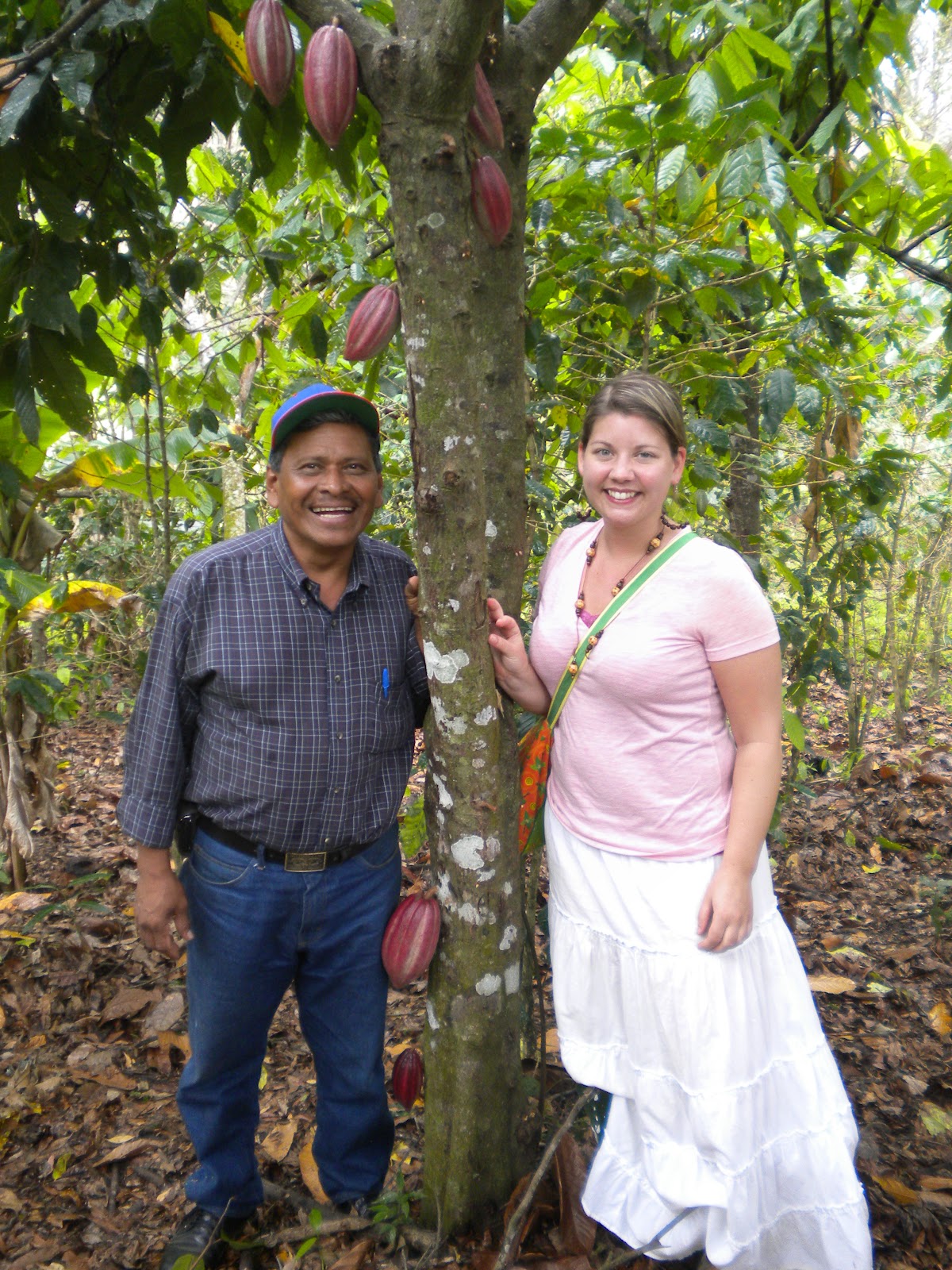
Cacao fruit, growing amongst the coffee bushes - it's almost ready to pick
Don Chico in his coffee beneficio


Cacao fruit - inside are white pods, like lima beans, covered with a sweet syrup (delicious to suck!), which contain the makings of a chocolate bar

Don Chico on his reforested hillside.  He says, "When I stand here, I am looking at the future".

Francisco Aguilar Guido  (Don Chico)
Don Chico is a CHE leader, community leader, coffee cooperative leader, coffee farmer, husband to Dona Lidia, and father of 8.  Only one child remains in high school; almost all the others are in some form of higher education.  Don Chico’s sons who work on the farm with him enable him to take the time necessary for his CHE work.   He lives in San Buenaventura
San Buenaventura is 14 kilometers from Boaco, in the central part of the country.  It has a population of 1200.
It is a farming community where people keep cattle, grow coffee, or basic grains, such as corn and beans.
I’ve lived here for 19 years, and when I came I had very little experience with different crops.  My parents only taught me to cut corn.  I trained with various organizations and projects so now I have a few cattle, grow organic coffee, and I work on the reforestation of my land planting a total of 1800 trees that are highly valued for wood.  I have cerro real, pochote, and teca, amongst others.
Natural reforestation is very important, too.  We take care of the trees that sprout in the woods.   I have 4,000 small trees that are growing naturally here.  
The climate has improved since the trees have grown, and Also the animals have come back - before there were no animals to hunt.  You see and hear the monkeys, and sloths.   These improvements help us take care of the family - there are 10 of us.  Helps us keep the children in school: 7 of the 8 are studying.  My children are working on the farm, fishing, studying medicine (1 son has 1 more year in medical school in Cuba), studying engineering, studying English to be a translator, studying law.
In CHE I work with the communities, and the neighbours.
From the spiritual point of view, I have seen changed lives.  Other projects only deal with the material, the physical - CHE brings the spiritual.
In San Buenaventura we work a lot with the families, people are converted to Christ.
I’ve learned about preventive health work, I led the project to get running water to our community. Now we are working on getting latrines for the 60 families here who don’t have them.  We are submitting a proposal to the regional government of Boaco asking for latrines.
Another 15 houses need electricity.
CHE helps us organize ourselves to work together.  For example, in El Capitan (a small community, 7 km up the mountain) they’ve made a 6 km road.
CHE groups have aquaducts for water, bringing water by gravity to more than 50 families; 15 beneficios (processing buildings) for small producers of coffee.  These beneficios enable the farmers to ferment and wash the beans in hygienic conditions, which improves the quality of the coffee.  Then, of course, they can get a better price.
Our coffee cooperative is working in 15 communities.  The members understand the importance of crop diversification, the importance of having fruit trees for the family, so that the children are eating fruit instead of junk food.  They can drink fruit drinks, instead of soda.  The members learn about farm administration in the co-op
They learn a lot through the co-op and through CHE.
Another great thing in our area is El Banco de Tierra (Land Bank), and working with David and Wendy vanKlinken.  There are many farmers who are almost out of debt, thanks to the Land Bank.
The neighbours notice the changes for the better.
And, for a year now, thanks to friends of David and Wendy,  
we have the little pharmacy right at my house.  They gave us $1000 for construction, later after we went over the accounts with them, they gave us $2000 to stock it with medicines.  The Ministry of Health partnered in this venture.  This pharmacy does not exist to make money, but to serve.  It has been a great blessing - it’s right here in the community, and it is cheaper than other pharmacies.
The people see what CHE does, so then they want to be involved.
We’ve also got families and individuals involved in repujado (decorative metal work) which they have sold in Managua, as well as to Nicamade.  (Don Chico’s son is a talented artist).  The women are doing crocheted  bags.
Another thing is carpentry workshops.

Sunday, January 29, 2012

Esneyda's Story

Esneyda at her sewing machine
Esneyda is a CHE community leader, in Balgue, Ometepe island, Nicaragua. This is her story of how she became involved in CHE, as she told it to us.
It will be good to hear the updates in a couple of weeks when we are in Balgue again.


Esneyda Morales
Vice-president of the church Women’s Group, and of CHE in Balgue.
Aged 33, married, with 2 children.
It all started with an invitation to church.
Then I was chosen to go to a training in another community.  Pastor Cecilio and I went.  Then at the next training we learned to make ear-rings.  This sewig class to make bags is the third training I have had.
I like CHE - it helps people.  It attracts people who like to learn, and motivates them. A lot of women don’t work, and they don’t have any skills.  Their day-to-day work is boring.  So the CHE classes give them new opportunities.
I work as a dressmaker, and I have my clientele - that’s important.
I came to know Jesus in Sunday School, when I was 12 years old.  My father is a pastor.  
We have our own house, but we rent it out, and live here with my parents to help them.  Otherwise, they’d be on their own here.
Balgue is not very developed.  There are 4 small hotels.  people like the work that comes along with the tourism, for example, in the hotels.  There is a secondary school, a primary school.  There is a project, Hand of Friendship, and my mother is the community coordinator.  There is money from the UK and Germany to teach women to cook things, like bread, that they can sell.
God always helps me, blesses me.  My vision, or what I am most interested in, is that women learn so that they can get ahead in life - that they become friends of the gospel, and are converted.

The following photo shows Esneyda, and another CHE worker, with the draw string bags that are made by girls at Cheltenham High School, Pa.  They contain sewing kits for the women to use to make the bags in the class.  The girls also include messages, and many of the women send notes back to the girls.  


Tuesday, December 13, 2011

Fatima's story - photo below

Fatima del Carmen Medina
Regional CHE leader.

Aged 29. Married, with 3 children: Guidman, 13, Wilmington, 7, Abery, 3.
Lives in El Limonal, Chinandega

I began working with CHE in 2001 through the Nehemiah Center, in Managua (www.nehemiahcenter.org). We formed a CHE committee in El Limonal, and trained other women in preventive health care, promoting good health, and the abundant life in Jesus.

Everything I have learned in CHE has helped me so much.
I have learned to connect with many people, both foreigners, and nationals. I have been to other communities to share what I have learned. I feel very happy when I see women who have learned at my trainings.

Saturday, August 6, 2011

Introduction to Darling Lopez, Women of CHE Facilitator, Nicaragua

Darling and Kelly Diaz in folk dancing costume

I worked with closely with Darling during the 3 years I spent in Nicaragua as a Food for the Hungry Hunger Corps worker.  It was a great blessing to learn under her leadership, and I treasure her friendship.  We attended the first Women of CHE conference in San Jose with Charlene McWilliam (of LifeWind, who created the first Women of CHE classes).  We were both part of the first Women of CHE  National Gathering, in Nicaragua, along with Hermano (brother) Antonio Vivas, and Roger Pavon, held in Boaco, Nicaragua.  In September, 2011, we will be attending the first Women of CHE conference for all Central America, in Guatemala.
Each year, since I left Nicaragua in 2006, my husband and I have gone back to Nicaragua, with a friend or 2, and Darling, our friends, and I plan activities for women in the communities that the CHE team chooses for us to work in.  
I was able to ‘interview’ Hermano Antonio and Roger for this blog while we were in Nicaragua this year. However, during our time in the communities, Darling was either meeting with leaders, or dashing off on a motorcycle with a terrified Women of CHE leader clinging to her back, to visit other CHE groups, so her ‘interview’ will have to wait until Guatemala.
In the meantime, here is her prayer letter from autumn 2010.


                                    Darling and her husband, Jose Antonio (Chico)
Prayer letter 
From Darling Lopez, 
Community Health Evangelism, Nicaragua
Dear brothers and sisters,
My name is Darling Lopez de Ramirez.  I am 32 years old, married to Pastor Jose Antonio Ramirez, who worked with Medical Ambassadors for over 12 years in the Dominican Republic.  I have 2 children: Alicia, 16, and Andres, 12.
Let me take a little of your valuable time to acquaint you with the beautiful life path that God has shown me over the course of the last 10 years.  I refer to the ministry program, Community Health Evangelism, through which I came to accept Christ.  He immediately sent me to work in the CHE ministry.  I met my husband at a CHE residential training course in Guatemala.  Thanks to the support of the Thomas family in Denver, Colorado, and God, I graduated as a lawyer and notary public.  Now I work as resource facilitator for the women of the CHE program.

Saturday, July 30, 2011

Roger Pavon's story

We are happy to share with you the testimony of Roger Pavon, in which he describes his dedication to CHE work.  Roger serves as treasurer for CHE, Nicaragua, as well as CHE Coordinator for the region that includes Nicaragua, Honduras, Costa Rica, and Panama.  As we sat in a new church in Leon, on the edge of the city, with a new urban CHE group, Roger told me his story.  He appears in the photo with Pastora Mercedes seated, left,  Pastora Lourdes, seated, right, and Bill Freund.

Roger Antonio Pavon Sotelo 
I was born into a Catholic home, but when I was 10 years old my parents started to go to an evangelical church.  This was where I heard about Jesus and the Bible for the first time.  At age 14 I accepted Christ in Sunday School:  Jesus is the rock, and those who cling to this rock are safe.
So I began my Christian life.
After the Triumph of the Revolution, (1979) I joined in the government literacy campaign, and the anti-malaria campaign.  In my church I became a Sunday School teacher, and national president of the church (FIEMCA) youth organization.
I obtained a degree in Industrial Engineering at the University of Managua.
This was followed in 1985-1986 by military service.  Afterwards, my life was very busy: I was studying, working in the church, and I got married. My wife is Griselda Guevan Chavez.

In 1992, I was elected secretary of the mission (FIEMCA) together with brother Antonio Vivas.  Working together, we began giving workshops to pastors about the holistic ministry of the church.  We were concerned about the way that the churches and the communities that surrounded them were living separate lives.
There is a saying: Pastors are the key.
We trained the pastors, but we did not have a practical strategy for holistic ministry until brother (Dr) Hugo Gomez (Regional Coordinator for Central America, who lives in Guatemala) brought Community Health Evangelism.
CHE came by means of Medical Ambassadors (now LifeWind) after Hurricane Mitch devastated our country in 1998.  In June 1999 we had our first Training of the Trainers for CHE with 18 pastors.  From that first training came 2 teams:  one, in Daniel Guido, in the department of Nueva Guinea, and the other in San Juan, in the department of Boaco.  With that first training, John McWilliam and Hugo Gomez, of LifeWind, brought the seeds of CHE to our country.
In 2000 brother Antonio and I began to implement the CHE ministry in Nicaragua.  We helped bring Luis Palau, and the singer, Judy, to Nicaragua to celebrate the 100 year anniversary of the gospel in our country. 
Also in 2000, I worked with the Timothy Committee, later with the Nehemiah Center, continuing to expand the CHE territory with both the Nehemiah Center and FIEMCA while receiving support from Medical Ambassadors, LifeWind, and CHE Global Enterprises.  
As time went on CHE grew from 2 local training teams to 15, then from 15 to 40 CHE trainers.
Now we have 12 CHE programs in Nicaragua in Boaco, Leon, Chinandega, Ometepe, Masatepe, and Nueva Guinea.  New programs, or better said, new ministries, continue to open.
My life purpose, from now until the Lord takes me, is to continue impacting as many people as possible with the gospel of the Lord Jesus, and involving churches, communities, and organizations in the CHE ministry, as much as I can. 
In 2010 we began Urban Transformation (urban CHE) in Leon and Chinandega.  Now there are 7 churches involved, working in 6 urban neighbourhoods.  There are many challenges to Urban Transformation, and one of the most significant is that, in contrast to the rural communities, there is not a strong sense of community overall.  We have to look at the communities within the larger city, and the fundamental community for this work, especially in the city, is the church.
The foundation on which the work of CHE must be built is the training team - it’s the base of everything.  One person alone cannot do the work.  It has been so important to be able to work with Darling and brother Antonio, with all the help and accompaniment of brother Hugo Gomez, and everyone connected with the CHE ministry.
I must say, too, that the support of my wife has been essential to my ability to dedicate myself to this work.  The support of our spouses allows us to be away from our families while working in the communities.  I have 2 children in high school, Urias Israel Pavon Guevan, and Gisell del Carmen Pavon Guevan, both believers, whose faith is strengthened by the many answers to prayer they experience  as our family prays.

Wednesday, July 20, 2011

Hermano Antonio Vivas, Coordinator of CHE FIEMCA, Nicaragua, shares with us some of the highlights of his ministry, and how he came to be involved in CHE


Hermano (brother) Antonio Vivas and his wife, hermana Mirna, in Urbaite, Ometepe, in February, 2011.

We are so happy to be able to share with you the brief glimpse into his life and ministry that Hermano Antonio gives us in the following paragraphs.  He is a great man of faith and service.  I'll add that he and hermana Mirna were just married last October.

Here he is:


I accepted the Lord on the 8th of August, 1973.  It happened during an evangelistic visit by a pastor who was going around preaching.  He had a family service in Zelaya, near Nueva Guinea.  He spoke on the story of Lazarus and the rich man.  When the pastor explained the gospel, I made my decision.  
It took a whole day on horseback over very rough roads to get to the pastor’s church.  The pastor came to see me once, and I went to the church once, in one year because of the distance.  I was baptized within a month, but for five years I was inactive in my faith because of the isolation.  However, I listened to Christian radio from Costa Rica.
In 1976 we left that isolated place to give our children the opportunity to go to school.  Later my wife left me and our children.  We had 5 children, and the youngest one was still crawling.  Their grandmother took care of her.
At Nueva Leon. in a little church, I took a Bible correspondence course, and learned basic principles.  I began visiting the neighbours, and the first man accepted Christ, along with his wife and their large family.  It was at Christmas time.  For 5 years I helped the pastor in this church of 70 people.
In 1978 I became a pastor, but without training.  Other pastors came to bring communion, I could only preach and teach.I worked in agriculture at the same time.  I never thought to be a pastor.
  The revolution happened in 1975, and between 1982 and 1983 the church split between Sandanistas and Contras.  Forty five people stayed with me.  The others went and joined a mennonite church.  I resigned in 1984 - the situacion had become very bad, and I believed that it was necessary for the church to have a different pastor.
After the 1984 elections came the Contra revolution.  I was at La Esperanza, in the El Shaddai church.   I went to Nueva Guinea to work, and take care of my family.  Most of the pastors had fled, if they could.  There were many people and pastors who had to go into military service.
In that region, region 1, there were 38 churches,  and the number rose to 55.  Because there were no pastors left, more had to be trained, and I was chosen to do that training and education.  For 7 years I was the only pastor taking services in this area.  We did graduate 2 pastors, but they would not enter the communities at this time: it was dangerous because of the contra war.

 I wanted to leave the pastorate, but I went on, and I was ordained, because of my work in the communities during the contra war.  It was a very tense time, but the ministry was beautiful.  After the war, in Nueva Guinea, I had the opportunity to participate in the Peace Commissions - in 1986 to 1991. Many people were demobilized in that period.  I still remember the first person who came to know the Lord at that time - Pedro Figaro.  He wanted to be baptized, so I invited him to devotionals with me - and he came to know Christ.

People appreciated my testimony because I was neutral politically, and just concentrated on the gospel.


 Later, I wanted to learn agronomy, but I was accepted into a course that  CEPAD .was offering - in human rights.  There was a group of young men and we struggled on behalf of minors, the sick and so on.   Everything was voluntary - God clothed us.


In 1991 Auxilio Mundial made an agreement with our denomination, FIEMCA, in the region.  Freddy, the FIEMCA president, said to me, "We are going to work in agriculture".  This made me very happy
Also in 1991, the Wholistic Biblical Training Center for Pastors at Zelaya trained us, and from that training, came a movement of wholistic ministry.  This was what I wanted - I dreamed of CHE long before I heard of CHE.

Later in 1991 the process began for elections to the National Council of FIEMCA (the Fraternal  Evangelical Church of the Mission to Central America) and, to my amazement, they chose me as one of the candidates.  I said it was crazy, but then I realized that I was resisting like Moses, so I accepted the candidacy.  And I became president of the council.  In 1992, I moved to Managua because of this position.

When I arrived at the office I didn't know anyone.  I worked as part of a team with a very understanding colleague.  I was president for 4 years, and then Roger (Pavon) was president, also for 4 years.  I helped him.  While I was president I organized the coordination of regional councils.  By now, my children were adults.

In 1999, both Roger and I resigned our positions, because, at that time, Don Hugo Gomez came (from Guatemala) and brought CHE to Nicaragua.  We immediately wanted to be part of this ministry, we took the 3 training of the trainers classes, and started work to train others in 2002.  We had no money, but a friend in Germany helped us.  Then an agreement was signed between FIEMCA and Medical Ambassadors (now Lifewind) and we began to be paid.

Roger took on the coordination of CHE, and I helped him.  The Nehemiah Center helped Roger, as well.


To sum up, the 3 stages in my ministry are as follows:

1)  From 1978 to 1984 I was pastor of El Shaddai in La Esperanza.

2) From 1984 to 1986 I went from congregation to congregation (because the pastors had fled) taking   communion, baptizing - doing the ceremonies.  And participated in the Peace Commissions.

3)  From 1992 to 2000 I was involved in administration at FIEMCA, and then went on to work in CHE until the present (2011)


Monday, July 11, 2011

Ana Kerina's story - she is a CHE leader in Balgue

Ana Kerina Alvarez Alvarez
aged 27,married, with 4 children
I was at church and the pastor invited all the members to come to a CHE meeting, and said that this was an important opportunity.
I went to the meeting,there were just 4 of us from the church, and Darling and her husband, Chico, were there.  They explained what CHE is, and encouraged us to keep our homes and our children clean in order to improve our children’s health.
There weren’t many people there the first time, but there were 14 at the next meeting - I invited several people.
I began in my own house: encouraging and counseling others, practicing and teaching what I was learning.
It was difficult at times, because I have 4 children, but I was interested, and I saw it as important work.
At the third meeting we felt as though it would not be possible, but Neyda and I were visiting and encouraging the 14 who had come. We made ourselves available, we trusted in the Lord, and we were seeing that we could do things with the Lord’s help.
Later, we had meetings in the church, one of which was with the Women’s group.  The church Women’s Group supported  the development of CHE.  We talked about different ideas.  I was president, and Neyda was Vice President of the Women’s Group, which was organized to work within the church, but not for CHE.
The pastor was very happy with the meeting, We talked about the things we had done as part of CHE so far, and this really motivated the whole church.
Some of the women in the sewing class to make bags are not believers.  These activities help to bring in people who are not yet believers.  The class was fun, and motivates us to do things to get ahead in our lives. It was a blessing to see people there who are not believers. I saw women there who did not want to praise the Lord at first, but later they joined in.  
I shared my Bible with someone.
There were 2 girls, and I said to Neyda, pass me your Bible, so the other girl could have one, too.  Later, the pastor gave her his Bible, and after that, she was singing, too.
After the class, everyone was so happy with their bags.  Every few minutes they were saying to each other, They’re so pretty!
For me, it was a great blessing.  I would love to have a little shop, with sewing machines, and women would make things, and sell them. 
I accepted Jesus in an evangelistic service that I went to with my mother.  Sister Candida invited us.  We got separated, so it wasn’t until afterwards that we discovered that we had both begun new lives in Him that day.  My husband is a believer, too.  

Sunday, July 10, 2011

Welcome to the Community Health Evangelism, Nicaragua blog

The purpose of this blog is to share with you the work of individual, family and community transformation that God is doing through the CHE ministry (Christian community development strategy) in Nicaragua.

Communities are working on, and achieving goals such as clean running water, latrines for every household.  People commit to their community and to the Lord Jesus.

Individuals are starting tiny businesses, with CHE classes and supportive mentors, receiving visits from neighbours who care enough to commit to bringing all they learn from the monthly CHE classes to others in their community.  People come alive in Jesus, (and the discovery that God has a purpose for their lives) in their opportunity to learn, and in their relationships with each other.

Families are changing as Jesus enters their lives, and chaos is replaced by commitment to each other's well-being.  Money begins to come into the home instead of the bar. Children start going to school.

Women discover their abilities through new opportunities, through learning, and classes that specifically deal with women's and family health.